Italiano
 Français
 Deutsch
 Switzerland


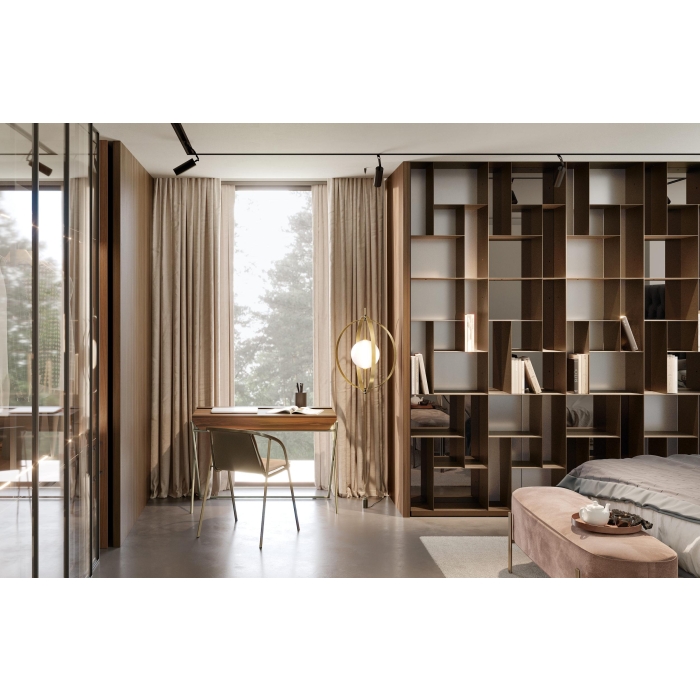
A bookshelf is one of those pieces of furniture that truly makes a difference, especially in the living room. It is primarily a highly practical storage unit that can be configured in different ways depending on its use, the space in which it will be placed, and the arrangement of other furniture. It can be modular, freestanding, wall-mounted, tall or low, with shelves and even compartments. It is one of the easiest pieces of furniture to personalize and can also be custom-made, taking into account the choice of materials, colors, finishes, and, of course, the type of configuration. In addition to being spacious and functional, it defines the living area with presence and elegance, even renewing a minimal or dated living room.
However, when it comes time to choose one, the doubt is almost always the same: should you opt for the material warmth of wood, which fills and envelops, or the lightness of iron, which redefines spaces with modernity? On one hand, there is a more classic bookshelf, perhaps matched with other wooden furniture in the living room; on the other hand, metal structures are perfect for modern, industrial, or minimal interiors.
The question arises naturally: is it better to have a metal or wooden bookshelf? In this buying guide, we will try to resolve the dilemma, starting from what really matters: how you use your living room, how much space you have, the atmosphere you want to create, and whether you need the bookshelf to be primarily for storage or, on the contrary, more decorative.
Before choosing between a metal or wooden bookshelf, you need to understand how you will actually use it in your living room. Are you buying it because you need a storage unit to display books, store documents, highlight albums and design objects, or are you looking for a more decorative element with perhaps a few selected volumes and some design pieces on display?
A bookshelf designed as a storage unit requires deep shelves, large dimensions, a stable structure, and a strong presence. A lighter bookshelf, on the other hand, features open modules, irregular compartments, and small niches dedicated to displaying objects.
Another key point is understanding whether the bookshelf will occupy an entire wall—thus becoming the focal point of the living room—or if it will simply be an auxiliary piece, alongside other furniture such as sideboards, TV units, or cabinets. In the first case, full-height solutions, custom compositions, or wall units make sense, whereas in the second, freestanding, suspended, or open models work well, interacting with the rest of the furniture without overcrowding the space.
Finally, also consider practical elements. Think about the number of books: if you have many, you’ll prefer a solid structure; if there are children or pets at home, be careful as they may climb or pull items from the shelves. Always consider the space, as a very deep and fully loaded bookshelf does not work well in a narrow living room.
Now let’s look in detail at the differences between metal and wooden bookshelves.
Structurally, a metal bookshelf is an excellent choice when you have many books, decorative objects, or even entire archives to display. Metal ensures great stability and can easily handle heavy loads, reducing the risk of shelf bending or structural sagging over time. It works well both as a standalone unit and in full-wall compositions, especially when you want a visually light but technically robust structure.
Another advantage is durability. Unlike more delicate materials, iron is not prone to deformation, is resistant to humidity (if properly treated), and withstands daily wear, accidental impacts, and frequent movement of books.
In practice, a metal bookshelf maintains its shape and functionality over the long term, providing a reliable structure even when every single shelf is fully loaded.
How does a metal bookshelf look? It is characterized by thin profiles, clean lines, and open structures, filling the wall without weighing it down.
Mixed versions, with wooden shelves and a metal frame, are ideal for contemporary living rooms that do not want to give up a warmer, more tactile component.
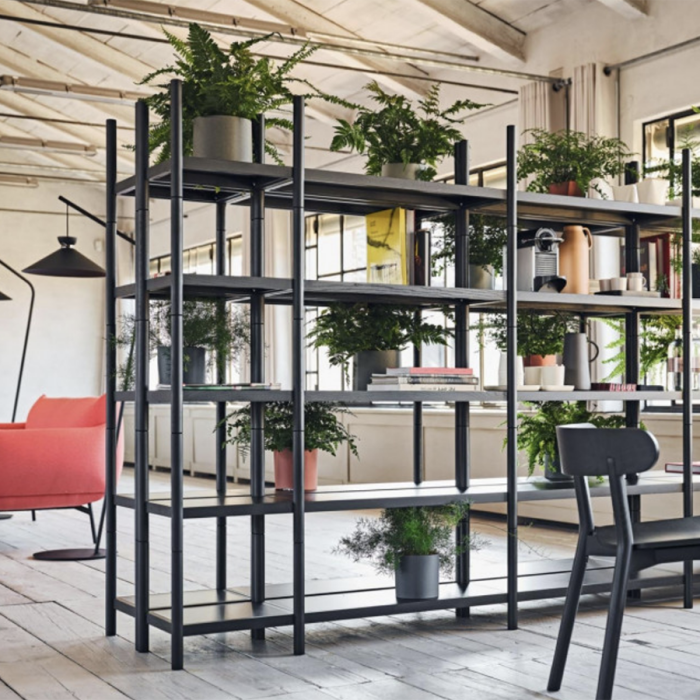
The Siena bookshelf by Midj is an open modular bookshelf that combines the solidity of wood with the sophisticated lightness of metal or glass shelves, creating an elegant but never intrusive presence in the living room.
Thanks to combinable modules, it allows you to build custom compositions, from a single essential column to full bookshelf walls, adapting to both compact living rooms and larger open spaces. It is an ideal solution if you are looking for a contemporary bookshelf that brings different materials into dialogue, creating a precise balance between function and design.
Another strong point is the variety of metal finishes: from matte black and graphite for an industrial effect, to sanded white or metallic and bronze tones for elegant spaces, up to more saturated colors designed as decorative accents in neutral rooms.
However, keep in mind that metal bookshelves, especially when very tall, freestanding, or open, require careful planning and custom wall fixings to prevent oscillations, minor movements, or, in the worst case, the risk of tipping over.
A wooden bookshelf is a classic but always current choice. Wood is a material with timeless charm, bringing an immediate sense of warmth to the living room, related both to its tactile quality and the way its grains interact with the light and colors of the space. Placed in the living area, it makes the room more welcoming, especially if it matches the woods already present in the floor, table, or other furniture.
Functionally, wood performs best in wall-mounted or modular bookshelves: closed and open modules, open compartments, doors, and drawers allow you to alternate books, display objects, and more discreet storage, creating a perfect custom wall unit adapted to the habits of the household. Wooden modular solutions offer ample storage capacity and can evolve over time, adapting to new needs without disrupting the harmony of the living room.
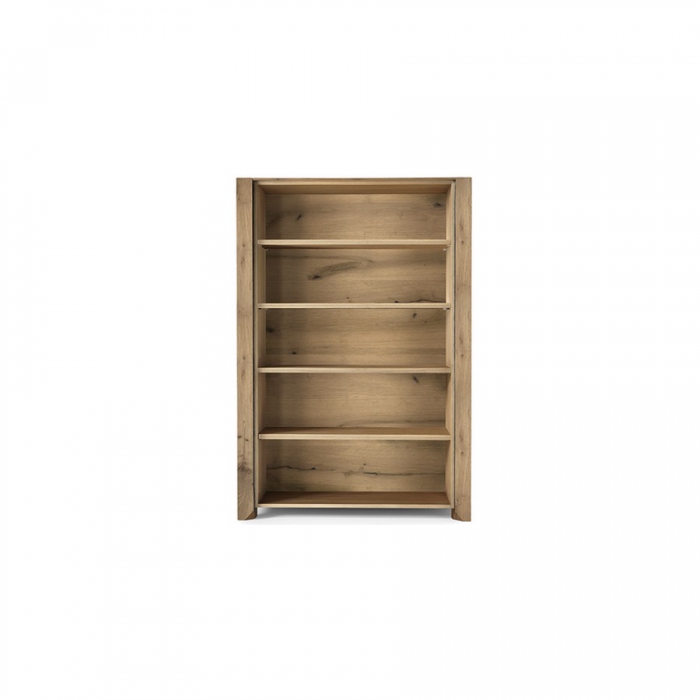
Living room bookshelf in aged oak or walnut, available with wooden or iron legs, features a contemporary and elegant design capable of giving any environment a charm that intertwines tradition, warmth, and formal research. The collection is made of aged oak with iron inserts: the combination of these two very different materials generates an effect typical of the current industrial style and represents an original choice to furnish the home with a truly distinctive touch.
However, you should know that compared to other materials, wood requires a bit more care. In more delicate species, it can be affected by humidity and temperature fluctuations, and some surfaces may scratch from impacts or rubbing, especially in high-traffic areas. For this reason, it is important to evaluate finishes, protective treatments, and maintenance routines to preserve the appearance of the bookshelf over time.
If your living room is small, contemporary, and you have many books but do not want to weigh down the space, an iron bookshelf is often the most suitable choice.
A wooden bookshelf works better when you are looking for warmth, continuity with other furnishings, and a strong presence. It is therefore the ideal choice if you want a cozy, material-rich living room consistent with existing floors and furniture.
As always, there is also a very interesting third way: bookshelves in iron and wood, with a metal structure and wooden shelves or storage modules, which allow balancing materiality and lightness.
Which one do you choose?